Licensing exam in Russia after MBBS: complete guide for Indian students
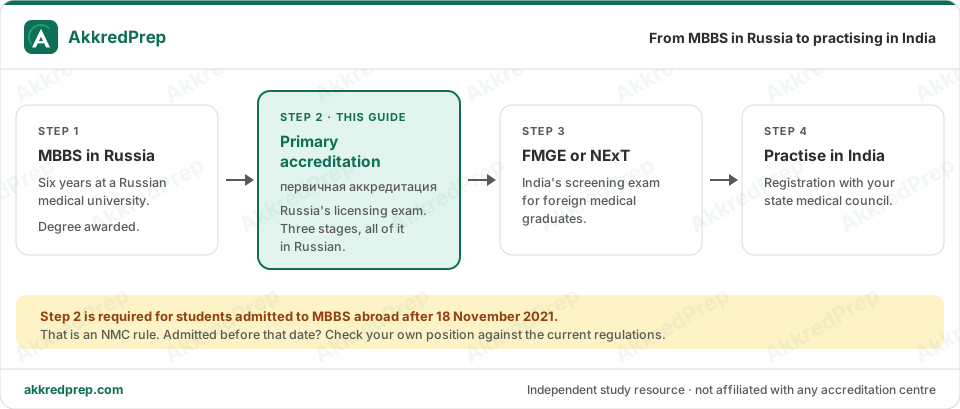
Indian students admitted to MBBS in Russia after 18 November 2021 must pass Russia's licensing exam, primary accreditation (первичная аккредитация), before they can sit FMGE or NExT in India. It has three stages: an MCQ test, practical skills stations and situational tasks. All three are in Russian, and most students sit them in June–July after their final exams.
By Dr Vivek Lathwal Updated 26 October 2026 9 min read
The licensing exam in Russia is called primary accreditation (первичная аккредитация). For General Medicine (Лечебное дело) it has three stages: a computer-based MCQ test, a practical skills exam at OSCE-style stations, and situational tasks built around patient cases. Every stage is in Russian. If you were admitted to MBBS in Russia after 18 November 2021, NMC rules say you must clear it before you can sit FMGE or NExT and practise in India. Most students sit it in June or July, straight after their final exams.
This page is the overview. Not sure whether the rule applies to you at all? Do you need to clear the accreditation exam? works through the admission-date cut-off, transfers, academic leave and the cases where it is still unclear.
What is primary accreditation?
Primary accreditation is the exam that gives a medical graduate the right to practise in Russia. It is roughly Russia's equivalent of a licensing exam such as FMGE in India or USMLE in the United States.
You sit it after you finish your degree. Passing it is separate from your university's final state exams. Clearing your finals does not give you accreditation.
Why do Indian students have to pass it?
The rule comes from the National Medical Commission (NMC). Indian students admitted to MBBS abroad after 18 November 2021 must be eligible to practise as a doctor in the country where they studied. For Russia, that means passing primary accreditation.
Without it you cannot sit FMGE or NExT, and you cannot get your foreign degree recognised for practice in India.
If you were admitted before 18 November 2021, the rule may apply to you differently. Check your own position against the current NMC regulations before you decide to skip the exam.
What are the three stages?
You have to pass all three stages in order. You move to the next stage only after passing the one before it.
| Stage | Russian name | Format | What you face | Time | Pass mark |
|---|---|---|---|---|---|
| 1. MCQ test | Тестирование | Computer-based | 80 questions, 4 options each | 60 minutes | 70% — 56 of 80 |
| 2. Practical skills | Практические навыки | In person, simulation centre | 8 stations | Set per station | Examiner checklist |
| 3. Situational tasks | Ситуационные задачи | Computer-based | 2 cases × 12 questions | 30 minutes per case | 70% |
Stage 1: the MCQ test
- 80 questions in 60 minutes, which is about 45 seconds per question.
- The computer draws your questions from a national question bank.
- Each question has 4 options and exactly one correct answer.
- You need 70% or more — 56 of 80 — to pass.
The time is the part students underestimate. Knowing the material is not the same as recognising it in Russian in under a minute, forty-five seconds at a time, eighty times over.
Stage 2: practical skills
- Held in person at a simulation centre, on manikins. It cannot be taken online.
- Examiners mark you against a checklist at each of 8 stations.
- Stations cover history-taking, physical examination (cardiovascular, respiratory and GI systems), basic adult CPR and airway management, emergency care, IV injection and preventive health screening (dispensarisation).
- The station list is set centrally and can change. Check the current list with your accreditation centre.
Stage 3: situational tasks
- Two patient cases, each followed by 12 questions, so 24 questions in all.
- Each case is timed separately, with 30 minutes per case.
- Unlike Stage 1, the number of options varies: some questions have 4 and some have 6. You are not told how many answers to pick.
- The pass mark is 70%.
This stage tests clinical reasoning in Russian. You read a case — history, examination, laboratory results — then answer questions on diagnosis, investigations and management. The full breakdown of each stage is on the exam explainer.
What language is the exam in?
Russian, for all three stages. There is currently no English version.
Some students hope this will change. It helps to look at it the other way round: FMGE is not held in Russian or Chinese for students who studied abroad. Every country examines its doctors in its own language. For now, plan on Russian only.
That makes medical Russian part of the syllabus. Knowing the medicine in English is not enough if you cannot recognise it quickly in Russian under time pressure.
When and where do you sit it?
Most students sit it straight after their final exams, in June or July.
You take it at an accreditation centre. This may be a simulation or accreditation facility inside your own university, or a separate centre in your city.
You are not tied to your own university's centre. You can choose a different centre, a different date or a different city. Exam dates are mostly published on university websites, and they change from year to year.
What happens if you fail a stage?
This is the part that causes the most confusion, so it is worth going slowly.
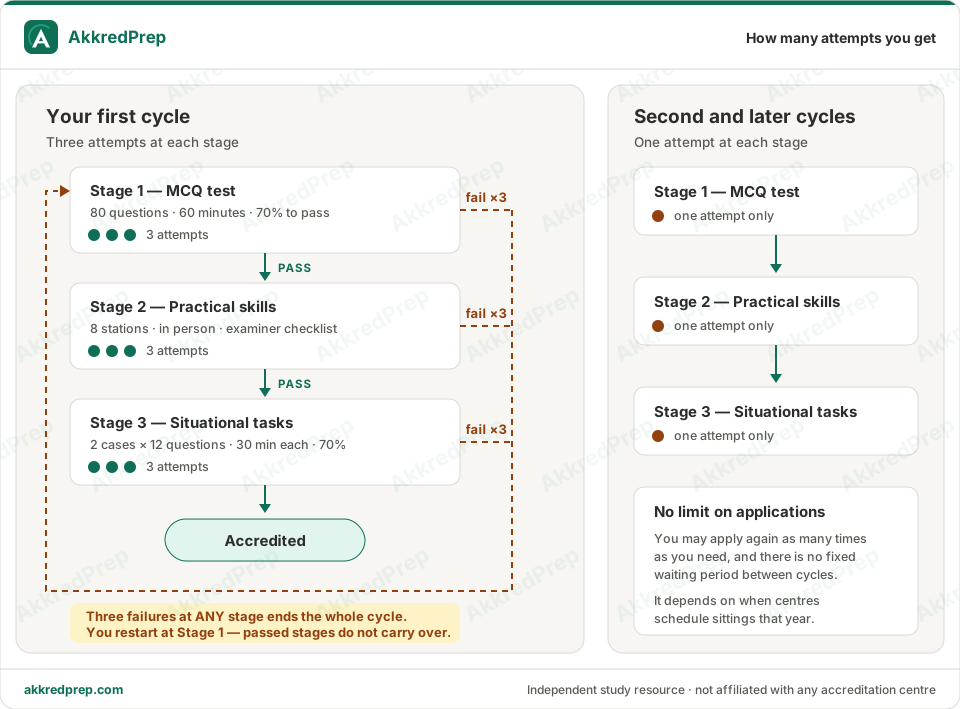
The rules differ between your first cycle and every cycle after it. Confirm the current rules with your accreditation centre, because they can change.
Your first cycle
- You get up to three attempts at each stage.
- Stages run over several days, so a retake may be the same day or the next day, depending on the centre's schedule.
- Pass Stage 1 and you move to Stage 2, again with up to three attempts. The same applies to Stage 3.
If you use up your attempts
- If you fail all three attempts at any stage, the whole cycle counts as failed. You receive a document confirming this.
- Next time you start again from Stage 1. Passed stages do not carry over. Failing Stage 3 means sitting Stages 1 and 2 again too.
That last point is the one people miss. Three failures at Stage 3 does not mean three more tries at Stage 3 — it means the whole thing again, from the MCQ test you had already passed.
Later cycles
- You get only one attempt per stage.
- There is no limit on how many times you can apply.
- There is no fixed waiting period. It depends on when centres schedule sittings that year.
| First cycle | Second and later cycles | |
|---|---|---|
| Attempts per stage | 3 | 1 |
| If you use them all | Whole cycle fails | Whole cycle fails |
| Where you restart | Stage 1 | Stage 1 |
| Passed stages carry over? | No | No |
| Limit on applications | — | None |
Your first cycle is the one with room for error. That is the main reason to arrive prepared rather than treat it as a practice run.
Why do students fall short?
Very few Indian graduates have sat this exam so far. Most of those who have are students who chose to stay and work in Russia. So there is not yet a large track record to learn from.
The weak points are still easy to predict:
- Starting too late. The exam comes weeks after finals. If you leave it until sixth year, accreditation preparation competes with your final exams.
- Not practising MCQs. Reading theory is not the same as answering 80 questions in 60 minutes.
- Memorising answers instead of the language. Questions are drawn from a large bank, and the wording you see on the day may not match what you memorised. If you know the Russian medical terms, you can work out a question you have not seen before. If you only memorised which option was right, you cannot.
- Leaving Stage 2 to chance. Practical stations are marked against a checklist. Missing steps costs marks even if your clinical judgement is sound.
When should you start preparing?
Ideally in fourth year. That gives you two years to build medical Russian alongside the medicine, without competing with finals.
If you are already in fifth or sixth year, start now. The exam is in June or July, and every month of steady practice helps.
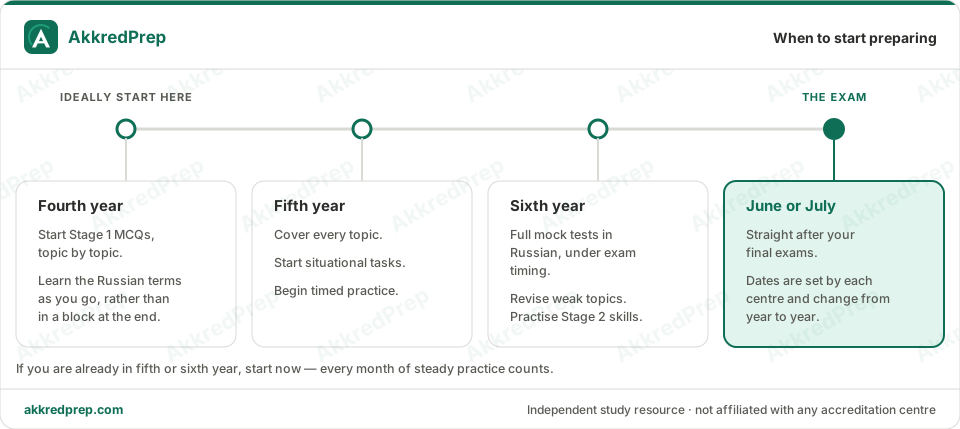
A sensible plan looks like this:
- Fourth year: start Stage 1 MCQs topic by topic. Learn the Russian terms as you go rather than in a block at the end.
- Fifth year: cover every topic. Start situational tasks. Begin timed practice.
- Sixth year: full mock tests in Russian under exam timing. Revise weak topics. Practise Stage 2 skills at your university's simulation facilities where you can.
How can AkkredPrep help?
AkkredPrep is an independent self-study platform. It is not affiliated with the Russian Ministry of Health, any accreditation centre or any university, and it does not run the exam.
What it covers today:
- Stage 1: 4,052 MCQs across 24 topics, each with the Russian original, an English translation, a glossary of Russian medical terms and a written explanation. Practise in English, then sit mock tests in Russian only, in the real format.
- Stage 3: 812 situational tasks, each with 12 questions, practised untimed or timed.
- Stage 2: preparation material is planned but not yet available.
You can try questions on the free demo before deciding. Plans and prices are on the pricing page.
Where can you check the official rules?
Your accreditation centre is the authority on dates, station lists, retake rules and anything else specific to your sitting. If this guide and your centre disagree, follow your centre.
For eligibility in India, check the current NMC regulations for foreign medical graduates. Do you need to clear the accreditation exam? covers what the regulations say, who is exempt, and how to get your own position confirmed.
More guides
-
Do I need to clear the accreditation exam in Russia? (Admission after 18 Nov 2021)
Yes, if you were admitted to MBBS in Russia after 18 November 2021 and want to sit FMGE or NExT in India. NMC's FMGL Regulations 2021 require a licence to practise from the country where you studied, and in Russia that means passing primary accreditation. If you were admitted before that date, you are exempt.